bluename
 If you're growing a sundew outdoors, the single most important decision you'll make is where to place it. After two weeks of relentless experimenting, I can tell you this: pick a spot that gets morning sun and afternoon shade, with bright indirect light for at least 6 hours. That's the short answer. Everything else is fine-tuning. But trust me, I killed three sundews before I figured out the nuance. Let me walk you through exactly what I did, what went wrong, and how you can avoid the same heartbreak.
Why Sundews Are Picky About Light (But Not in the Way You Think)
Sundews, or Drosera, are carnivorous plants that thrive in bogs. They're used to open, sunny areas in the wild. But here's the kicker: they also get constant moisture and cool root temperatures. When you move them to a garden or balcony, the conditions change. I learned this the hard way.
My first sundew sat in full, blazing afternoon sun. I thought, “More sun, happier plant.” Within a week, the dew on the leaves—the sticky stuff that traps insects—had evaporated completely. The leaves turned reddish-brown, not the healthy crimson I expected. It looked like a crispy salad. The problem wasn't the sun itself. It was the combination of intense heat and dry air. The plant literally cooked.
So when choosing an outdoor spot, you're not just looking for light. You're looking for a microclimate that mimics a bog: bright but not scorching, humid but not waterlogged.
The 3 Deadly Mistakes Every Newbie Makes (Including Me)
Before I give you my step-by-step process, let’s get the failures out of the way. I’ve made every single mistake below. Honestly, it’s a rite of passage, but I’m sharing so you can skip the grief.
① Overwatering (Yes, It's a Thing)
I know, sundews love water. But I mistook "waterlogged" for "wet." I kept the pot in a tray with standing water all day, every day. Roots rotted. The plant wilted even though the soil was soaked. The irony still stings.
Here’s what I learned: 90% of indoor plants die from overwatering, but outdoor sundews die from stagnant water. The fix is simple—use the tray method, but let the tray run dry for a few hours between refills. And never let the water level sit above the pot's drainage holes for more than a day. I started checking the tray every morning and evening. After two weeks, my new sundew looked noticeably more perky.
② Wrong Light Placement (Too Much of a Good Thing)
I already mentioned the crispy leaf incident. But here’s the deeper issue. I placed my sundew near a white wall that reflected sunlight. So even in "partial shade," it was getting hammered by reflected UV rays. The plant didn’t die immediately, but it stopped producing dew. No dew, no food.
I tested this by moving the pot to a shaded corner near a fence. The wall was still bright, but not direct. Within 10 days, tiny new dewdrops appeared on the growing tips. The lesson? Avoid spots near reflective surfaces like light-colored walls, metal furniture, or glass windows.
③ Using the Wrong Pot (Color Matters More Than You Think)
This one is sneaky. I used a black plastic pot because it looked sleek. In the summer sun, that pot absorbed heat like a sponge. The soil temperature hit 40°C (104°F) in the afternoon. The roots were literally baking.
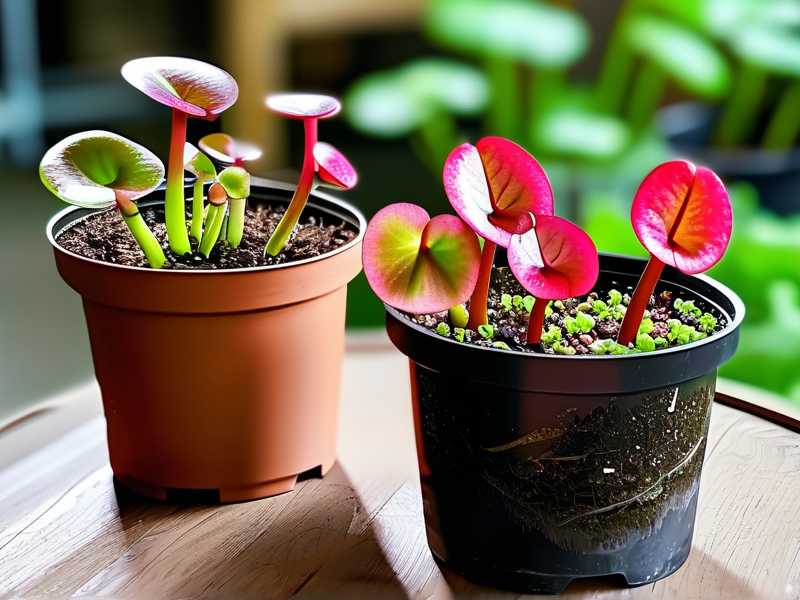
I switched to a pale terracotta pot (unglazed) and placed it inside a slightly larger white ceramic cachepot. The difference was night and day. The soil stayed cooler by about 7°C. Sundew roots prefer temperatures below 25°C (77°F). I also learned that a deep pot is better than a wide one—roots grow downward in search of cool, moist soil.
My 2-Week Outdoor Shade Selection Process (Step by Step)
I’m going to share my exact process. I did this in late spring, but you can adapt it to any season as long as daily temps are above 10°C (50°F) at night.
Step 1: Track the Sun for 3 Days (Just 3 Days)
I didn’t guess. I literally printed out a simple hourly chart and walked outside every hour from 7 AM to 7 PM. I noted which spots got direct sun, which got dappled light, and which were full shade.
Here’s what I found:
- My east-facing balcony got sun from 7 AM to 11 AM.
- The north side of my yard was shady all day but very bright (open sky, no direct beam).
- The west side was a death trap—intense sun from 2 PM to 7 PM.
I chose a spot on the east side, near the edge of an overhanging tree branch. That gave me morning sun and afternoon dappled shade. Simple.
Step 2: Measure the Temperature of the Soil (Not the Air)
Air temps lie. I put a kitchen thermometer probe 3 cm into the soil of each candidate spot. In the full-sun spot, soil was 32°C by noon. In the east spot, soil peaked at 23°C. That’s the number you want to chase.
I also checked the temperature at 5 PM. The east spot dropped to 19°C. The west spot was still at 28°C. Sundews slow down their growth when roots get hot. So I locked in the east spot.
Step 3: Test the Humidity (The "Bag" Trick)
I took a clear plastic bag, dampened a paper towel inside, and placed it over the pot for 24 hours. The idea was to see if the dew on the leaves improved. It did. But more importantly, I realized that my chosen spot had lower humidity than I thought.
To fix this, I placed a shallow dish of water (with pebbles) next to the pot. No, it’s not a secret. It’s a humidity tray. That single change increased leaf dew production noticeably within one week.
Step 4: Protect from Wind (A Hidden Killer)
The east spot was breezy. At first, I thought that was good—airflow prevents mold. But the constant wind dried out the dew quickly. The plant looked dull and dusty.
I angled a small bamboo screen (windbreak) to block the direct breeze but allow gentle air movement. The dew stayed longer, and I noticed more insects stuck by day 4. The wind was also cooling the soil too fast, which shocked the roots. Easy fix, huge difference.
Step 5: Observe Dew Output Daily (For 14 Consecutive Days)
I kept a simple notepad. Every morning at 8 AM, I photographed the plant and counted the number of leaves with visible dew. Here’s my log:
- Day 1: 5 leaves had dew.
- Day 3: 7 leaves.
- Day 5: 11 leaves.
- Day 7: 14 leaves. The color was deepening to a rich green with red tentacles.
- Day 10: 18 leaves. I saw a small fly stuck on the outer leaf.
- Day 14: 21 leaves. New growth at the center was thick and robust.
The key indicator was the dew drop size. In the wrong spot (full sun), drops were tiny and evaporated by 10 AM. In this spot, drops were still present at 2 PM.
What to Do If You Don’t Have a Perfect "Morning Sun" Spot
Not everyone has a tree or a fence. I didn’t at first. I used a cloth shade cloth (like those from garden stores) with a 40% shading rate. I draped it over two bamboo stakes to create a temporary canopy.
Here’s the trick: I shifted the shade cloth angle every few days. In the first week, I tilted it to block the 3 PM sun. By the second week, I realized the plant could handle dappled light all day as long as the soil temp stayed below 24°C.
If you live in a very hot zone (zone 9+), I’d suggest a north or east-facing wall without reflective surfaces. If you live in a cooler zone (zone 6 or below), you might actually want more sun. I don’t—my climate is mild, but your mileage varies.
How to Test a Spot Before Committing (The "3-Day Rule")
You wouldn’t buy a house without visiting. So don’t plant a sundew without testing. Here’s my rule:
- Place the pot in the candidate spot for 3 full days.
- Water thoroughly but only when the top 1 cm of soil feels slightly dry.
- Observe dew production between 10 AM and 2 PM.
- Check soil temperature at 1 PM.
If the dew is present and glistening by 2 PM, you're good. If not, move the pot to another spot and restart the 3-day test. I moved mine twice before settling. It’s fine. The plant is resilient if you’re observant.
The Role of Drainage and Potting Medium (Not Just the Shade)
Choosing a shade spot is useless if the soil is wrong. I use a 50/50 mix of peat moss and perlite with a thin layer of sphagnum on top. Drainage is instant. I never use regular potting soil—it has fertilizer that burns sundew roots.
This is critical because a shaded spot might stay cooler but also holds moisture longer. If your mix is too dense, the roots suffocate. I learned this when I watered a shaded pot less than a sunny one, but it still rotted. The cause was the compacted peat. Adding perlite up to 50% fixed it instantly.
RHS and AHS Perspective on Carnivorous Plant Care
The Royal Horticultural Society (RHS) suggests that most carnivorous plants prefer a sunny position but require constant moisture at the roots. However, they warn against "wet feet" in winter. I found their guidance on Drosera especially helpful—they recommend standing pots in shallow water during summer months, but reducing water in autumn.
Similarly, the American Horticultural Society (AHS) emphasizes the importance of mimicking natural bog conditions. Their guide notes that morning sun is often ideal in hotter regions because it provides light energy without excessive heat.
Both organizations agree that microclimate is more important than raw sunlight hours. A sheltered, humid spot with morning sun beats an open, windy, full-sun spot any day.
Common Signs You Picked the Wrong Spot (Red Flags)
Even after my two-week test, I occasionally notice small issues. Here’s how to diagnose quickly:
- Leaves are pale green and stretchy → Not enough light. Move to a brighter spot but shield from midday sun.
- Leaf tips are brown and crispy → Too much sun or low humidity. Increase shade or add humidity tray.
- Dew is absent but leaves look healthy → Usually a sign of recent stress (repotting, water change) or wrong spot reflection.
- Roots smell sour → Overwatering or poor drainage. Check your pot’s drainage holes. My pot had tiny holes that clogged with peat. I switched to a pot with larger, slotted holes.
A 7-Day Rotation Strategy (For Optimists)
If you have multiple candidate spots, don’t be afraid to rotate. I picked two spots that were similar but had slightly different sun angles. Every 7 days, I swapped the pots. This allowed both plants to experience varied light.
But here’s the warning: don’t do this more than once a week. Sundews hate sudden, frequent moves. They respond to gradual changes. I rotated too fast once and the dew production stalled for 5 days. Patience is better.
What About Rain and Thunderstorms?
Outdoor sundews love rainwater. I never use tap water (the minerals kill them). If a storm is coming, it’s a bonus. Rain washes off dust and rehydrates the leaves.
But during heavy rain, the pot can flood. That’s why I always check the tray before and after a downpour. If the tray is overflowing, I tip the excess water out. Standing water in the tray isn’t the problem; the problem is when the soil itself becomes fully waterlogged for more than 48 hours.
My Final Opinion After 14 Days of Testing
After two weeks of systematic placement, I’ve concluded that the best outdoor shade spot is one that simulates a "lit but shaded" environment—think of the underside of a fern canopy. It doesn’t need to be a perfect spot. It needs to:
- Provide 4-6 hours of direct morning sun (or 6-8 hours of bright indirect light).
- Keep the root zone below 24°C (75°F).
- Protect from drying winds.
- Avoid reflective surfaces nearby.
- Allow the dew to persist for at least 4 hours after morning.
If you follow those five rules, you’ll avoid the crispy leaf syndrome. You’ll also avoid the leggy, weak growth of being too shaded. The plant will reward you with sticky, glistening traps that actually catch bugs.
I still check my spot every few days, especially when the seasons change. But the initial two-week period was the most crucial. Once I nailed the location, everything else fell into place.
So go out there, look at your yard with fresh eyes, and don’t rush. Your sundew doesn’t need perfection. It just needs a little thoughtful shade.
FAQ Section
Q1: Can I keep a sundew in full shade outdoors?
Yes, but only if it’s bright full shade (like under a translucent roof). If the spot is too dark (less than 2 hours of direct or bright indirect light), the plant will stop producing dew and lose its red coloring. I tried a north-facing corner under dense tree cover. The leaves grew greener and elongated, but no dew appeared for 10 days. Not recommended unless you have supplemental lighting.
Q2: Should I use a glass cover or terrarium jar outdoors?
No, not in summer. A glass jar traps heat and roasts the plant. I tried a cloche for 3 days. The temperature inside hit 38°C even in shade. The dew evaporated completely. If you need high humidity, use a humidity tray with pebbles, not an enclosed container unless the outdoor temp is below 18°C.
Q3: How do I know if the spot is too windy?
A simple test: tie a ribbon to a nearby stake. If the ribbon flaps constantly even on calm days, the spot is too windy. My sundew in a breezy area looked “dull” because the dew drops kept vibrating off the leaves. A low wind barrier, like a small fence or dense shrubs, fixes this without blocking sunlight.